

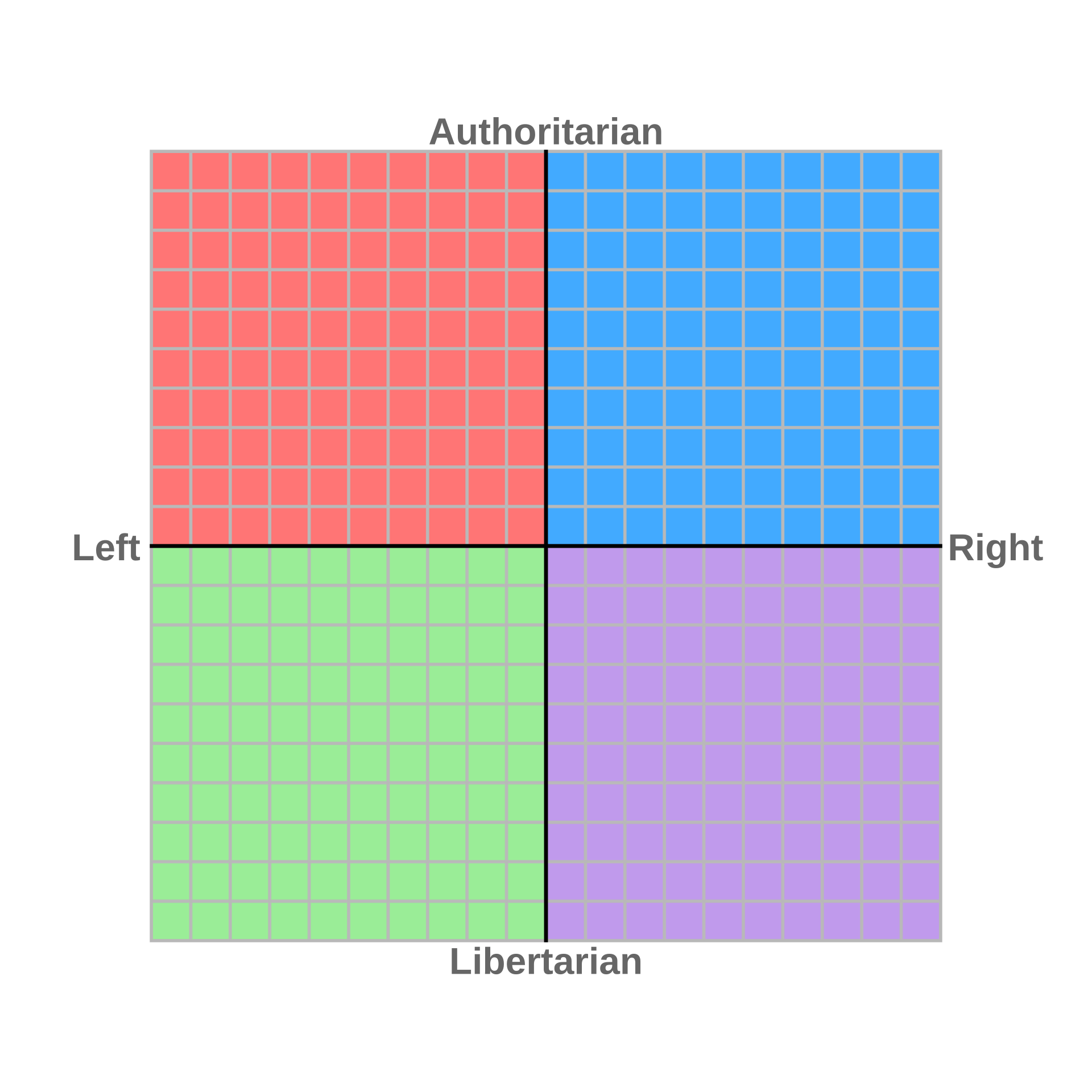
The “Political Compass” splits people’s political views across 2 axes:
Economic policy (left–right): do you favor state redistribution, welfare state, socialism, central planning or free markets, capitalism, competition?
Social policy (authoritarian–libertarian): do you want the state to interfere in people’s personal choices like what substances they consume, who they marry, how they are educated, or do you prioritize freedom and individual choice?
I find that people’s political inclinations are well predicted by their personalities.
People with a stronger egalitarian / fairness instinct favor left-learning economic policy
People with a stronger disgust response or lower openness favor authoritarian social policy
An underrated consideration about the authoritarian–libertarian axis is that it’s difficult to selectively move along it for certain issues and not others. Often I speak to people who have certain pet concerns—perhaps they think gambling is bad, or porn, or social media for teens. They want those things to be banned. However, maybe they also support gay marriage, people’s rights to change gender, freedom of religion, and so on. In their mind all these things are compatible—the government should simply adopt the correct values and ban the bad things and allow the not so bad things. But this model is very naive. Banning narrow things has second-order effects—you’re increasing the state’s remit to bad similar things. One day they’ll take the wrong side of one of your pet issues. So there’s a trade-off—if you advocate for the state to ban certain things you disapprove of, you must accept a higher likelihood of things you approve of eventually being banned too.
This is not the only reason to become more libertarian. Another one is if you terminally value people’s individual freedom to make their own life decisions, even when those might be incorrect.
Despite having an incredibly strong disgust response—i.e. I find most people’s life choices and preferences deeply offputting—these two phenomena (the second-order effects of narrow authoritarian policy, and the value of freedom per se) are sufficiently compelling to me that I’m a pretty extreme libertarian. More libertarian than almost anyone I’ve ever met. Sometimes people are surprised by this. For example, I think drinking alcohol or taking any drugs that make you stupider or less conscious is terrible (I can write pages and pages about how disgusting it is). Nevertheless I would never advocate for banning alcohol.
Sometimes I wonder why more people aren’t like me. All the high-disgust types I know end up as conservatives, always calling for things to be banned. All the libertarians I know are also quite laissez faire in their personal lives—they respect a wide variety of people and ways of life, they don’t come across as judgmental personally.
There’s a gap—where are the extremely judgmental libertarians? Surely there are other people who value their own and others’ freedom but nevertheless have strong opinions about what constitutes a beautiful vs. ugly life?
Unfortunately, saying that you consider something very bad is often misunderstood as advocating for intervention in discourse. But it is totally valid to make severe judgments about others while still believing they should be granted the freedom to do as they please.
>There’s a gap—where are the extremely judgmental libertarians? Surely there are other people who value their own and others’ freedom but nevertheless have strong opinions about what constitutes a beautiful vs. ugly life?
>Unfortunately, saying that you consider something very bad is often misunderstood as advocating for intervention in discourse. But it is totally valid to make severe judgments about others while still believing they should be granted the freedom to do as they please.
I think it's a combination of low base rate + selection effect (from the misunderstood dynamic you point out)
Eg I would (somewhat) put myself in this category, but I have no incentive to be public and loud about my negative judgments, because
1) it's rude
2) it's too easy for such statements to be weaponized by people who want to ban the things in question.
So I think libertarian + judgemental is not a memetically fit meme - no strong call to action.
Compare:
"this sucks, but i respect your right to do it" with
lib + non-judgement
"you are all Valid! Freedom!"
auth + judg
"this sucks, Ban It!!"
Very good post. I'm libertarian-ish and judgemental, so I've thought about this a lot myself. I think there are two aspects to this.
Firstly, the Ur-libertarian conceptualisation is often around something like "meddlesomeness." But most people, including most libertarians, do not have a high-minded moral or politico-theoretic view of state intervention. They want "what works" [i.e. what they think works] and the interventions they support map to specific outcomes they do or don't want. To the extent they have an overarching ideology, it is mostly after-the-fact justification rather than the core driver of their views. So it naturally follows that the people who support (say) drug legalisation are mostly unbothered if people take drugs.
Secondly, politics is coalitional, and we are shaped in various ways by our coalitions, both externally and internally. Libertarians are typically in coalitional alignment with conservatives. That means I am a little reluctant to attack my political allies if they make socially conservative statements I disagree with. But more insidiously, I get exposed to a lot of very strong arguments from very nice people who are a lot more socially conservative than me, more than happens for socially liberal arguments. And you have to be pretty Big-5 Disagreeable for that not to wear you down over time, if that pressure is aligned with your personal tastes anyway. So judgemental libertarians get moulded into conservatives, whereas the non-judgemental are better able to resist.