

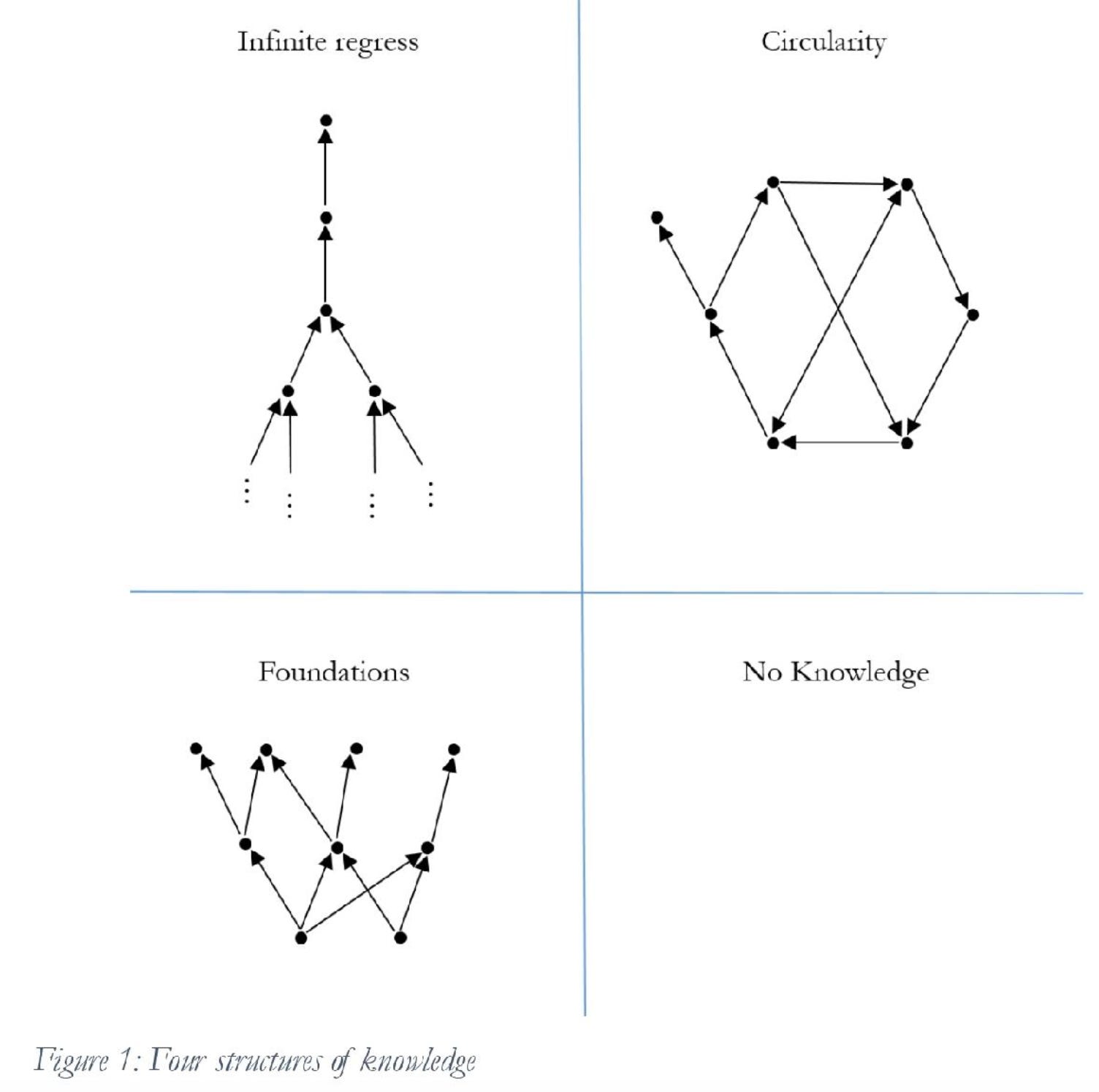
On a high level there aren’t that many ways knowledge can be justified (or not). This figure from the book “Understanding Knowledge” by Michael Huemer illustrates the options you have:
Infinitism: you require that everything be justified with reasons, so you require reasons for your reasons for your reasons, forever—infinite regress. “Infinitism holds that the key to justified belief is having an infinite, non-repeating chain of reasons standing behind each justified belief.”
Coherentism: At some point a reason that required a justification itself becomes a justification for something else. Quoting from the book: “Belief systems are justified by internal coherence. In other words, if you have a lot of beliefs that fit together really well, then that belief system is probably by and large correct.”
Foundationalism: At least some propositions are known without reasons.
Skepticism: You decide it’s impossible to know anything at all.
Foundationalism is generally the most popular view (~60% of philosophers according to the 2020 PhilPapers survey). Coherentism is second at around 20%. From Huemer again:
Foundationalists believe two things:
Some beliefs are justified in a way that does not depend on reasons, i.e., does not depend on their being supported by other beliefs. These are known as foundational beliefs, and their justification is known as foundational justification. (Also, propositions that we have foundational justification for are known as “foundational propositions”.)
All other justified beliefs ultimately depend upon the foundational beliefs for their justification. Everything must be built up from the foundations.
Despite the popularity of Foundationalism among current and historical philosophers, anecdotally I notice people appeal to Coherentism in lay conversations. Not explicitly, but rather at some point they’ll imply that they believe a system of facts because they all cohere. Then, if you press them, e.g. by pointing out that there could be multiple conflicting coherent belief systems, they reply by saying “well, ok, if I accept Foundationalism then I can simply assert that X Y Z are my fundamental beliefs and there’s nothing you can do to argue with me!”.
So I’d like to explain why this mode of thinking is mistaken. Adopting a Foundationalist epistemology doesn’t give you a carte blanche to believe whatever.
My preferred flavor of Foundationalism is Phenomenal Conservatism (PC), a term coined by Huemer. PC is an account of what justifies foundational beliefs without the requirement for reasons. In “Compassionate Phenomenal Conservatism”, Huemer formulates PC as follows:
If it seems to S that p, then, in the absence of defeaters, S thereby has at least some degree of justification for believing that p
PC is about seemings or appearances—a distinctive experiential state.
I take statements of the form “it seems to S that p” or “it appears to S that p” to describe a kind of propositional attitude, different from belief, of which sensory experience, apparent memory, intuition, and apparent introspective awareness are species. This type of mental state may be termed an “appearance.” PC holds that it is by virtue of having an appearance with a given content that one has justification for believing that content. We can see that appearances are different from beliefs from the fact that it may appear to one that p while one does not believe that p. This may happen, for instance, when one takes oneself to be experiencing a sensory illusion, so that one does not believe things are the way they appear; note that one’s lack of belief does not typically change the way things perceptually appear. The same holds when one suspects that one’s memory, intuition, or introspection is unreliable.
Huemer’s standard argument for PC is a self-defeat argument, where he claims that rejecting PC ends up in a self-undermining position. Specifically, he argues that:
All our beliefs (that are reasonable candidates for being justified) are based upon appearances.
A belief is (doxastically) justified only if what it is based upon constitutes an adequate source of (propositional) justification.
So, if appearances are not a source of (propositional) justification, then all our beliefs are (doxastically) unjustified (including the belief that appearances are
not a source of justification).
So it’s self-defeating to deny that appearances are a source of justification.
Unsurprisingly critics often attack (1). Huemer defends this as follows:
My reason for asserting (1) was introspection: When you think about it, it’s hard to think of any belief (that seems like a reasonable candidate for a justified belief) that isn’t based on appearances. E.g., my belief that there’s a table in front of me now is based on my visual experience of a table (which is a type of appearance). My belief that the shortest path between any two points is a straight line is based on my intuition that that is the case (i.e., it just seems obvious). That’s another kind of appearance. My belief that I woke up at 8 this morning is based on my apparent memory of this, which is a third type of appearance. To agree with these comments, you don’t have to already accept PC; these are just plausible to normal people on reflection.
I agree with this.
So, why can’t you, in an argument with me, say “Well X just seems to me to be that way so bam! I win the argument”?
Well, you can say that. Ultimately, it’s impossible for me to prove to an external observer—say, a perfectly fair and intelligent debate judge—that your seeming that X is true isn’t strong enough to overwhelm any conflicting seemings and their implications. PC is an internalist theory: what justifies your belief is your appearances. Nonetheless I might find this implausible and try to convince you by pointing out the implications of your other seemings.
Importantly, PC says that appearances get “at least some degree of justification” and only “in the absence of defeaters.” A defeater is information that undermines the justification a seeming would otherwise provide. A rebutting defeater is evidence that the proposition is false—including, notably, other people’s contrary seemings and your own conflicting intuitions. An undercutting defeater is evidence that the seeming itself is untrustworthy—for instance, learning that it was produced under the influence of drugs, cultural indoctrination, or motivated reasoning.
So though I can’t definitively refute a claim that your seeming is so strong as to overwhelm any competing evidence, that requires you to make this extraordinary claim—that the seeming is that strong. If you still have some uncertainty then there’s more to discuss, since we can start considering the implications of your other foundational beliefs and how those might act as defeaters.
Of course, it’s rarely necessary to trace beliefs you’re confident in to their foundational components. For example, for the purposes of many arguments we may agree that the rules of logic are correct, that mathematical relationships hold as usual, or that consensus historical or scientific information is true. So if I use some scientific facts to undermine your position, I am in some sense using one set of foundational appearances to undermine another, but I’m not going as far as to point out which foundational appearances underlie your confidence in the scientific facts, since we already agree on them.
Let’s consider a concrete example: I often debate people on moral realism. I’m an anti-realist—I don’t think moral facts are objective and mind-independent. Rather I think our moral instincts our downstream of our psychologies—subjective, personal, preference-based. Many others I speak to are realists, often because it seems to them, extremely strongly, that, say, torturing people for fun is wrong in some objective sense. Not just contrary to their own preferences, or disapproved of by society, but wrong in a way that would remain true even if everyone in the world (including them) became pro-torture.
In response, I mention an undercutting defeater: our moral intuitions ultimately exist in our brains that were shaped by evolution and natural selection. And they correspond suspiciously well to intuitions that would help individuals and societies have high reproductive fitness. While it makes sense that natural selection would result in eyes that accurately see things in the real world (since it’s necessary to interact with the real world to get resources and so on), there’s no particular reason to think natural selection would result in moral instincts based on objective moral truth (since there’s no reason to think that following objectively correct morality helps you survive and reproduce). In addition, different cultures end up with diverging and conflicting moral codes, seemingly well-suited to what helps them survive in their natural environment. So overall the process that produced our moral seemings looks unrelated to any notion of objective moral truth.
Analogously, let’s say you see a glass of water, and so you have a strong reason to believe there’s one on the table in front of you. This is reasonable until you find out that you were just drugged with a potion that is known to produce hallucinations of glasses of water. Then you are back to square one—you have little reason to believe that there’s a glass of water in front of you.
This argument for moral anti-realism is called the evolutionary debunking argument. Refuters may respond that we can’t know for sure whether our moral instincts are what evolution would naturally elicit for reproductive fitness. It’s possible that, if not for the effect of objective moral truths, our instincts would be different, for instance more self-serving. It’s of course impossible to evaluate this counterfactual. So whether or not you buy the evolutionary debunking argument depends on the relative strengths of the intuitions involved. Perhaps it seems more obvious to you that torturing children is objectively wrong than that any premise of the debunking argument is true. Nothing in PC forbids this, and then we end up with a genuinely insurmountable disagreement. The same argument functions as a successful defeater in my belief system and a defeated one in yours, and there is no neutral vantage point from which a fair and intelligent debate judge could rule on whose seemings are the right strength. That’s the price of an internalist epistemology.
Similarly, Mackie’s Argument from Queerness argues that moral facts are just too weird:
Every other objective property – like shape or height – just is. These properties don’t tell us what we should and shouldn’t do. It’s not like ‘squareness’ or ‘being 10 metres tall’ demand we act or don’t act in certain ways – they’re just physical properties and nothing more.
But for ‘good’ and ‘bad’ to exist as objective properties, then there would have to be something within e.g. the physical act of stealing that says “don’t do this!”. But it’s hard to make sense of how this would work – it’s hard to make sense how an objective property could command we behave or not behave in certain ways.
Metaphysically, this would be very strange – it would be like having ‘goodness’ and ‘badness’ atoms or something, and that’s a weird idea.
This is also a compelling argument to me. But again, if your moral seemings are strong enough, they might overwhelm this queerness. For instance, the “Companions in Guilt” objection to Mackie argues that the exact same accusation applies to the rules of logic and mathematics, which also don’t have associated atoms and may be described as “queer”. The difference for me is that my logical intuitions or seemings are much, much stronger than my moral ones. It is perfectly plausible to me that my moral instincts are entirely subjective and a product of biology and culture. But it’s much less plausible to me that my belief in logical entailments is mind-dependent and not true for everyone everywhere.
So once we reach this point in the argument, I can only urge my interlocutor to introspect and ask themselves whether, internally, their moral seemings are strong enough to overcome these various potential defeaters. I know that for me the answer is no. But maybe for you the answer is yes.
"We hold these truths to be self-evident". But really, I find myself in the weird position of (based on what you say here) having really strong intuitions that align with yours (hadn't heard of PC before, but I am a strong moral antirrealist, buy evolutionary debunking arguments and the argument from queerness but have high trust in math and logic). And yet I am constantly flabbergasted by how few people seem to be on the same page. Like, I would have imagined a priori that Rationalists would agree with this, and yet from my online impressions, a big chunk of them are realists of the consequentialist flavor.
I got stuck on the weighting. A contrary seeming can be a rebutting defeater, but how much it counts depends on how credible the person seems to me. That judgment need not itself be a seeming. On PC, though, it has to bottom out in further seemings somewhere, and those are open to undercutters too. I can discount your objection because you seem unreliable, then discount the challenge to that judgment because my own assessment still seems right.
Does PC constrain that weighting beyond the subject's total set of appearances? If not, what stops motivated reasoning from hiding there?