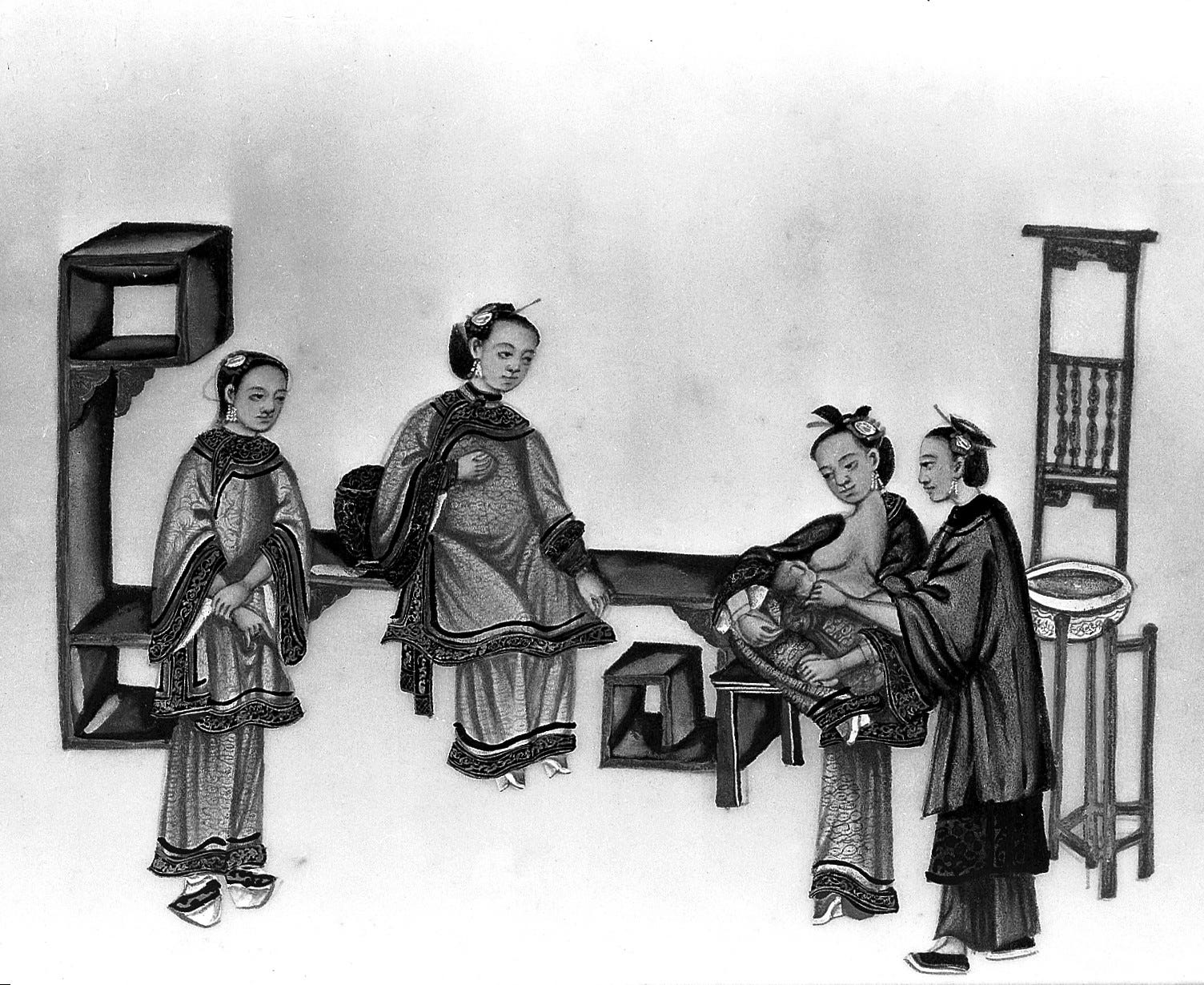
I recently read a couple blog posts about two mothers’ birth and postpartum experiences that reminded me of how different cultures have very different traditions from the ones I encountered amongst my own family.
Emily Ballesteros’ “I gave birth in South Korea and I’m lowkey traumatized” discusses the South Korean birth experience from the point of view of an expat. It’s a sad read, and tracks with my previous understanding of South Korean practices.
Nancy Hua’s “1 Month Postpartum” is not sad, but reminded me of the overlapping set of Asian postpartum confinement practices that I find interesting.
We hired a confinement nanny “yue sau” to live with us and take care of everything for up to the first 26 days. She cooked, cleaned, and mainly kept the baby in her room, only bringing him out for me to breastfeed. She promised to take care of everything, but I found I didn’t want her to. She kept wanting me to sleep, but I often couldn’t.
I first learned about Asian live-in postpartum care nannies from this tweet thread which caused me to look up sanhujori and then read about the broader concept of postpartum confinement.
Historically, in many cultures, the mother received a lot of postpartum help and support from her own mother. Often the mother would return to her natal home to live with her own mother leading up to the birth and for weeks afterwards. Alternatively, the grandmother would come to her daughter’s home. This shows up even in patrilocal societies—cultures where a woman normally lives with her husband's family. Birth becomes the exception when she returns to her own mother.
Japan is the most institutionalized example: satogaeri bunben, where the woman returns to her parents' home in roughly the last month of pregnancy and stays for one to two months after the birth, cared for by her own mother. South Asia is the other big cluster. Across much of India it's standard, especially for a first birth, for the woman to go to her natal home and staying through delivery and recovery. Similar patterns appear in Bangladesh, Nepal, and Sri Lanka. Whereas in Korea, sanhujori was traditionally done at the natal home, with relatives traveling to the mother.
This support was often also combined with “confinement”—the mother’s (and baby’s) contact with the outside world was minimized to help recovery and prevent infection. In China, this confinement period is called zuo yuezi (“sitting the month”) and lasts around a month. The mother must follow strict rules: avoiding cold, wind, and cold water, often not even bathing or hair-washing. In Korea, as mentioned, the term is sanhujori.
Though these confinement practices are ancient, newer versions of them have evolved with the increased wealth and atomization of society. Instead of staying with family, new parents from these cultures often either hire live-in postpartum confinement nannies or stay at postpartum care centers. This practice occurs both in Asia, and has traveled with the diaspora. You can find yuesao services and confinement centers in Chinese communities in the US.
The modernization of postpartum confinement came with a modernization of birth itself. In many East Asian countries today, birth is very medicalized and focused on the mother’s recovery and making things easy for her, rather than supporting the mother-baby bond and closeness. It’s very common to take the baby away from its mother immediately after birth and keep it in a nursery with only rare visitation periods for days or weeks after birth. This impacts breastfeeding establishment since the mother is only allowed to nurse at irregular periods, meanwhile the medical staff bottle-feed the baby formula in the nursery. In contrast, in the West (UK, Europe, US), the best practice is now considered giving the mother and baby a lot of immediate skin-to-skin contact, “rooming-in” (mother and baby sharing a room for the entirety of the hospital stay), and focusing on breastfeeding establishment with breastfeeding on-demand.
From Emily’s blog post on giving birth in Korea:
There were two breastfeeding times each day, one for two hours in the morning and one for two hours in the afternoon. As anyone who has breastfed knows, that timing is not helpful if you plan to exclusively breastfeed, you’re supposed to feed your baby every 2-3 hours. When they take your baby here, they start bottle feeding them formula immediately. If you want to breastfeed you can go to the breastfeeding hours, but you aren’t truly establishing a breastfeeding routine for as long as your baby is in their nursery. I had hopes of beginning breastfeeding immediately but that was just another hope I had to set aside for this pregnancy. I was crossing my fingers that she would be able to switch from formula in a bottle to breastfeeding when the time came
On barely being able to see her daughter:
I delivered my daughter the evening of the 10th and the soonest I could get up to see her through the gallery glass was the evening of the 11th. […] In the viewing area, you wait in line, walk up to the window, hold up your number, and they wheel your baby out. [..] After looking at her through the glass for our allotted 3 minutes, we went back to our room.
Interestingly, though perhaps predictably, most Korean women are unbothered by this setup, considering it normal:
Thankfully, she was able to latch during our visiting time. I sat there, topless in this room full of strangers, crying quietly over my daughter for the next two hours. I was the only mom to stay for the entirety of the visiting time- a reminder that this was not an unusual arrangement to the moms here, they were comfortable with this and not wracked with guilt. When visiting time came to an end, I tearfully handed the nurse my daughter to take back to the room of crying babies.
In many ways, I find this approach to birth very sad. How dare someone take a baby away from a mother and stop her from seeing it? How dare someone interfere with their biological rhythm and bond in a way that can cause permanent harm to lactation hormones?
But on the positive side, these cultures have evolved a large array of luxury postpartum services that many women prefer and like using, like live-in nannies and luxury care centers with gourmet food and hotel-like amenities. I’m not opposed to mothers receiving a lot of help early on if that’s what they want and choose—the part that bothers me is that way many women are forced to part with their infants when they don’t want to.
Reddit threads corroborate Emily’s recounting of the Korean birth experience:
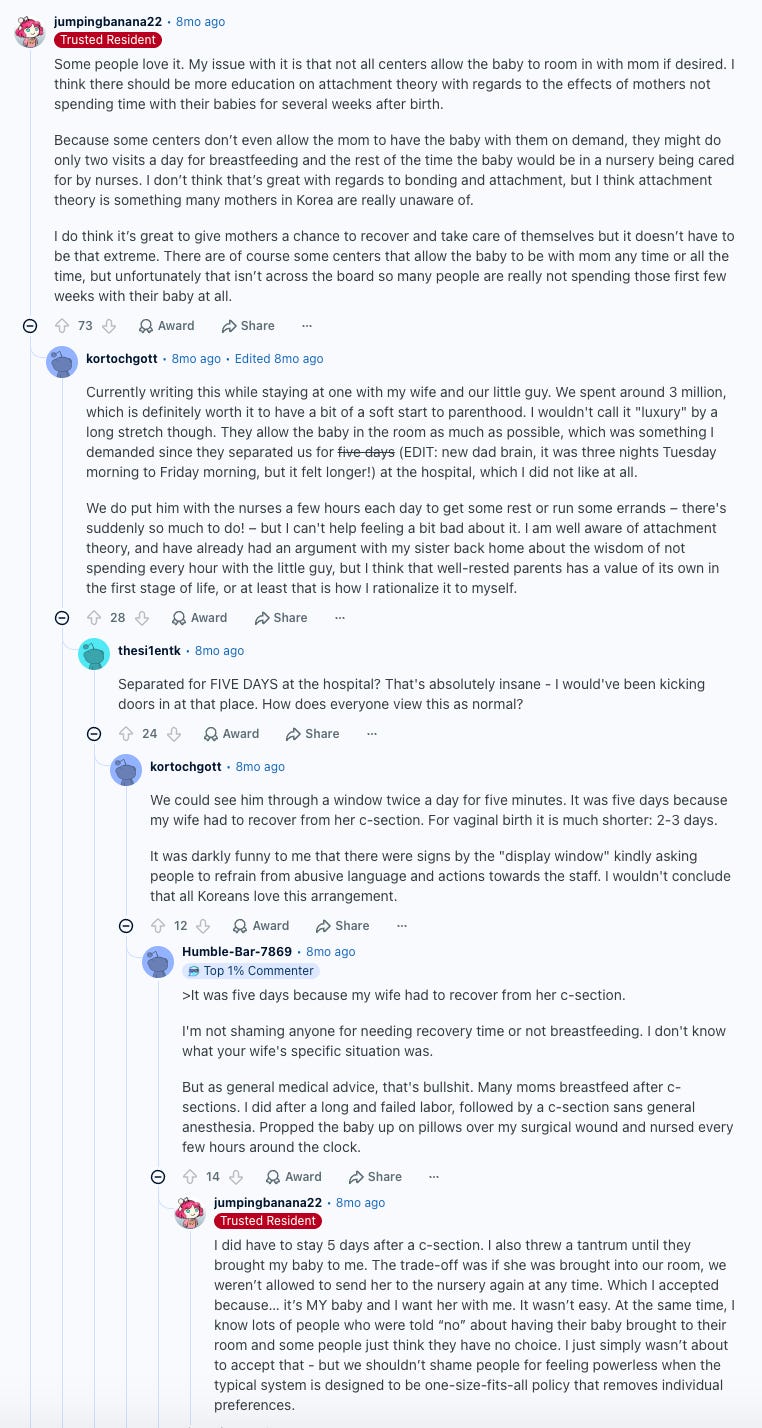
I had to fight quite hard to make the staff bring me my daughter the day after she was born, we had a private room so there was no issue with space or disturbing other patients. They just wanted to follow their typical policy which meant only seeing the baby twice a day for me until discharge and not at all for my husband, and I was not okay with that.
I’m on board with the positives of joriwon but I think there is quite a bit of work to be done to make sure mothers who choose not to spend time with their babies during their stay are making an informed choice and understanding of how that may affect bonding and attachment. And facilities should always allow parents full access to the baby at any time.
I declined joriwon at my hospital because they flat out told me I wouldn’t be able to have my baby with me and it was a twice a day thing. That just didn’t work for me.
One particularly sad part about forced formula-feeding is that mothers who don’t fully understand the supply-and-demand based system of lactation then think they wouldn’t have been able to breastfeed anyway. From Reddit:
so many Korean women think they "didn't produce enough milk" after going to joriwons and it's literally because of this. So many women here WANT to breastfeed, but aren't supported well enough to do so
Though it seems like even in South Korea it’s possible to find a place to give birth that won’t steal your baby. Might just take some searching:
We also chose a delivery hospital where we could do 모자동실, which basically means that two hours after the birth they bring the baby to your room and leave them with you until discharge. Totally normal situation in the west but we had so many friends, family, and medical staff telling us not to do it and that we wouldn't be able to cope. It was totally fine, fun, and a good experience despite not getting much sleep. But then sleep deprivation is something you have to get used to anyway so.... We stayed at the hospital with the baby in the room with us the whole time for 4 nights then went home. Might not work for everyone, but was the right decision for us.
(Though it’s funny that even here, in what the commenter seems to consider an unusually Western place, the mother and baby are separated for 2 hours after birth which is very long for an uncomplicated delivery in the West.)